Power
I don’t know why Niu Lai and Chinese People Can Fly appeared at the same time. Coincidentally, they surfaced online just before and after my trip to America. As for why I mention America—well, six seven. If we discuss Niu Lai alone, its explosion in popularity goes far beyond another ubiquitous piece of pop culture. Or perhaps it perfectly reflects this market’s most ‘real’ relationship between supply and demand. We all advocate freedom: freedom of consumption, freedom of markets. We say markets should determine demand. But fundamentally, that requires a healthy market, one that keeps things circulating and improving, rather than channeling money into something like this. The unfair income produced by this phenomenon can be destructive to the industry.
We can trace similar things back to the ‘three years studying animation’ videos that circulated online in 2019. Search Bilibili for ‘MAX-Xiaoxiannu’ if you want to dig them up. That wave produced videos as crude as Niu Lai—actually, slightly more polished. They emerged when animation still had formidable technical barriers. Animation students were mocking the poor advertisements they saw, in something like the self-deprecating jokes Cantonese people make about their Mandarin.
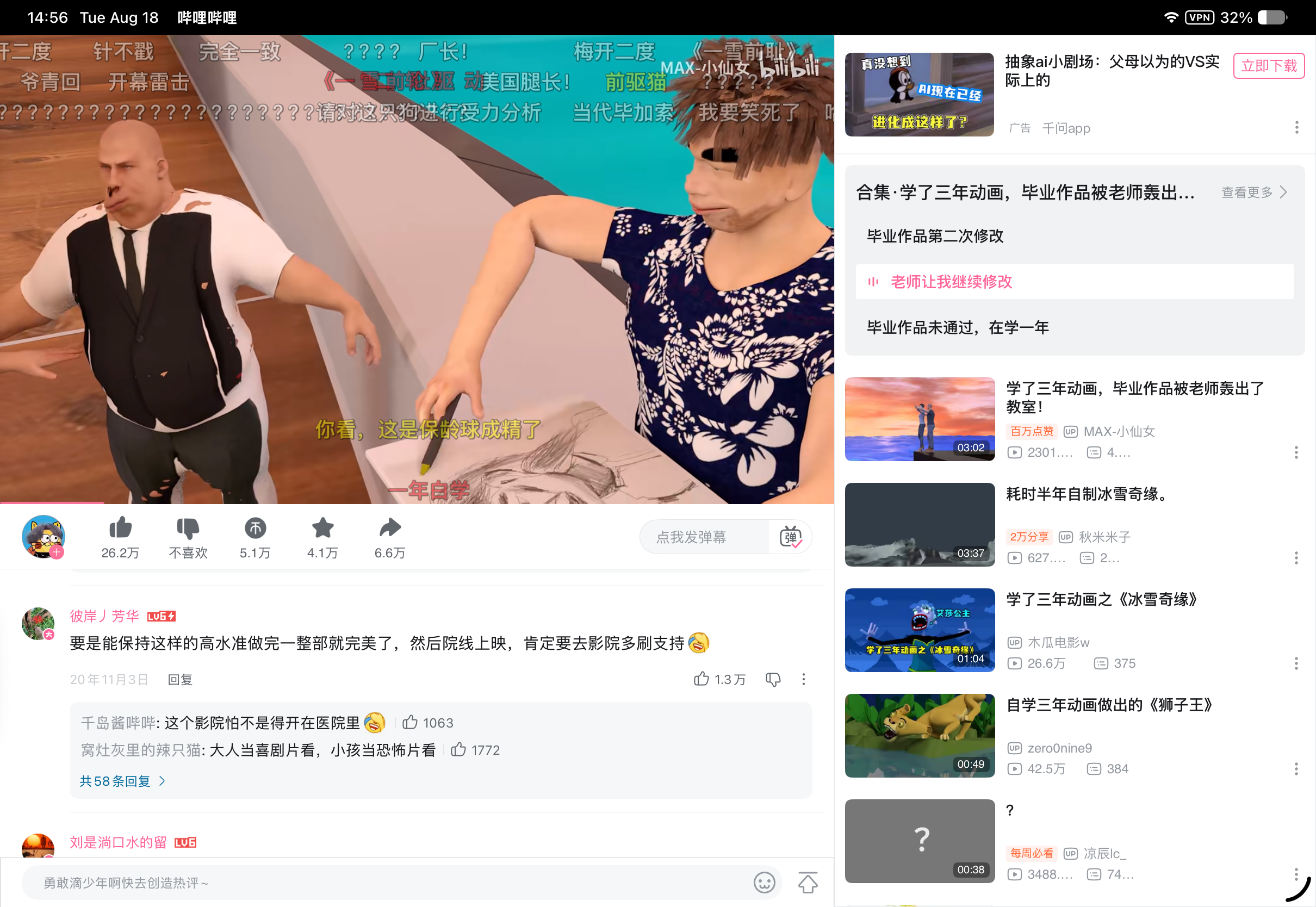
What bewilders me is people praising this film with ‘Wow, I haven’t laughed at something so purely in ages.’ Did they not laugh enough at the same thing in 2019, or did a pandemic pass and a different crowd start laughing all over again? The difference is that ‘three years studying animation’ remained a shared online memory, costing perhaps a few minutes and some data. This time, the film’s poor image quality and crude production are precisely what make people spend real money. Following a crowd is not necessarily terrible if the crowd is not heading somewhere bad; at worst, it is homogenization. But following a bad crowd—how is that not a desecration of cinema and disrespect toward people who paid to make something? Please don’t misunderstand me: you can make something like Letters to Grandma without spending much, can’t you? And after spending a lot, you can still ask people to ‘give you face.’
I am not opposed to ‘bad films’ themselves. A new director may have to climb upward from making bad films. They have their reasons to exist, and people are certainly free to watch, ridicule, or even enjoy them. Cinema cannot develop without people taking part. A cultural market that cannot accommodate failure, roughness, and absurdity would not be healthy either. Nor am I necessarily deeply opposed to memeification itself. People need shared references when joking: ‘Just Because You’re So Beautiful,’ ‘Japanese people really hate little boys,’ ‘isa.’ The difference is that these works first existed as works, before internet users excerpted, deconstructed, and remade them. Later, the memes acquired lives relatively independent of the originals. Yes, as an international student, I think memes like isa damage our reputation. Yes, as an international student, I now have another joke to share with friends. Still, I dislike this conformity. I prefer the people I know to be more varied.
Traditionally, a so-called ‘bad film’ fails to impress its first viewers, receives no further word of mouth, and is withdrawn and eliminated. That is how it ought to work, and how it has always worked. Unfortunately, when a work’s low quality stops being a flaw the market should eliminate and instead becomes an asset actively exchangeable for attention, box-office revenue, and even cultural standing, what exactly are our market and society rewarding?
Niu Lai was born into this distorted reversal.
Apparently, in the summer of 2026, people no longer needed to watch a work first and then make a meme from it. Instead, the work’s very lack of polish became the meme’s core, and the attention generated by that meme was converted back into actual box-office revenue for the original work. Something that should have counted as a liability in evaluating a work was transformed into an asset by the internet’s appetite for novelty.
Someone can, of course, say: ‘I’m just paying a few dozen yuan for a laugh. What’s wrong with that?’
From the perspective of an individual consumer, that is entirely valid. If someone knows a film is terrible but still considers two hours laughing with friends in a cinema worth a few dozen yuan, the transaction has utility for them. Likewise, someone may know perfectly well that a luxury item’s materials and functional value are far below its price, yet willingly pay for design, branding, identity, or emotional value. We have no reason to deny consumers the right to define their own utility.
But the problem is precisely that a cultural market does not consist of one isolated consumer.
When hundreds of thousands of acts of curiosity-driven consumption are aggregated, they cease to be merely hundreds of thousands of private entertainments. They become box-office figures; those figures become news; news becomes trending topics; trends further change algorithmic recommendations; algorithms produce new audiences; new audiences lead cinemas to schedule more screenings. Ultimately, a private ‘I paid a few dozen yuan for a laugh’ is translated by market mechanisms into a completely different public signal:
This thing has succeeded.
What frightens me about that success is that people even begin producing analyses whose sincerity I cannot distinguish, then rationalize it all as ‘sincerity,’ ‘supreme badness,’ or ‘pure happiness.’ Wow, so the director was conducting a social experiment, and we were part of his play. Hooray, I fell for it. Yes, exactly, I am riding its popularity too.
This reasoning is as absurd as the spectacle itself. Making people laugh is not a cultural product requiring no ability; it may demand extraordinary expressive skill. Two groups approach a similar goal, both making fools of themselves. Countless comedians, variety-show writers, directors, and others study where a punchline should land, how long a shot should last, what resources should be squandered when, and how to set up a sentence so an audience laughs thirty seconds later. Absurdity can be carefully crafted; vulgarity can involve tremendous craftsmanship. Entertainment is never inherently beneath so-called serious art. Our childhoods had Mr. Bean and Bernard to make us wholly happy; earlier generations had Chaplin’s silent comedy and Dayo Wong’s stand-up. Paying for happiness is perfectly natural, and ‘happiness and anxiety’ are at the heart of commerce. Well, perhaps all of that is still too complicated. Perhaps pure happiness can only be found by buying a big lottery bet and ascending to paradise.
Happiness and beauty certainly mean different things to different individuals. Yet they are also ranked, and require power to define them; otherwise we might live primitively like cats and dogs, with the sole truth of happiness being a full stomach and the ability to reproduce. Sorry, I have misspoken again: you are not a fish, so how do you know its joy—
A healthy cultural market should establish positive feedback wherever possible: better work earns more resources, more resources support better work, and better work raises standards across the industry. When a market cannot determine whether a product is good or bad, should its own barriers to entry filter it out?Following the Niu Lai issue further upstream leads to Chinese film censorship. So what are the standards for Chinese cinema? According to the distributor’s public statements in a media interview—source? An online interview that sounded like a customer-service phone call—they already knew the filmmakers. After seeing the finished film, they even advised against releasing it, but ultimately helped secure theatrical distribution because the filmmakers insisted. If that account is accurate, the problem predates the internet’s curiosity.
We can propose several contradictory hypotheses.
If this account is true, then, combined with Chinese cinema’s reputation, the industry was bureaucratic all along. Previously, though, that bureaucracy rested on money invested, or on ‘giving face.’ Fine, understandable: spending money on a film that does not harm society is perfectly natural in a capitalist society. But can a film now secure release through connections alone, without money? The premise is that the makers say they spent 100,000 yuan registering the company, produced the film with very little hardware investment, and ultimately relied on a mother supporting her son’s filmmaking and personal connections. We would conclude that the industry’s bureaucracy is cheap, and so is the power of public opinion. Yet reality contradicts this: Niu Lai turned a 7,000-yuan box office into millions. Unless millions count as cheap in China, this hypothesis fails.
If the account is false, the logic seems to work. This family invested enormous capital in private relationships rather than production, getting the film into cinemas. When ticket sales were poor, they put money into social-media platforms and bought traffic to revive them. That looks more like a distorted but potentially profitable investment. The value of power was not diluted; this time, intervention turned audience rejection into acceptance, making it a perfect strategic play. Our conclusion would be that this was a director’s social experiment, whose finding is that audiences are not audiences at all, but puppets of online public opinion.
If we imagine this society a little more kindly, it becomes a lovely Chinese family story: a mother’s tireless support for her child, exhausting every resource to realize the child’s dream, regardless of how good or bad the work is. The film happened to be born in an age of curiosity-seeking audiences, giving this child a chance to fulfill that dream. Our conclusion would be that everyone has the right to artistic expression, that art is egalitarian, and that as long as audiences like it, content and technique do not matter.
That concludes our discussion of Niu Lai. Let us return to power.
Power does not necessarily take the form of one person ordering another around. In a modern cultural market, deciding who gets to enter, what can be seen, and what deserves discussion is itself power. Power subtly influences behavior by shaping the information available to us, and thus our perception of the world.
Based on my earlier reasoning about truth, my framework can be simplified as follows:
I cannot prove an absolute objective truth independent of myself. What I can possess is provisional truth formed from currently available information while my cognitive system functions normally. When new perception or information arrives, I can revise it.
T= f(perception, available information, cognitive process)
More simply:Truth is not arbitrary, but it is information-dependent.
Different people’s shifting truths thus place society in an extremely dangerous position: conflicts between truths, and the question of how truths are constructed. If nobody can possess absolute truth, why do some people’s ‘truths’ become everybody’s reality?
When individual A considers X a fact and individual B considers Y a fact, this is simply an exchange of information between equals in the power to assert truth. A and B exchange information, become better informed, and reach a new collective provisional truth. But when group A considers X a fact while individual B considers Y a fact, the situation appears unequal in power. This is because numerically, group A is supposed to be more informed than individual B thanks to their population. However, this will again raise a Quantity-Diversity issue. Given that A is numerically more informed and B is diversely more informed, a personal judgement, which is based on empirical knowledge, of what the truth is will shift to a collective judgement, which is based on a negotiated empirical knowledge of what the truth is. During negotiation, power determines the conditions under which provisional truths are negotiated. Power is not a substance that can be removed, but a flexible tool that can be reshaped. That is, power may influence access to information, which consequently affects the formation of provisional truth.
Such influence requires some degree of control over the channels through which information is distributed. Information does not diffuse independently. It requires channels to reach different individuals, while these channels themselves require resources to establish, maintain, and expand. Yet, this does not mean that information simply flows towards whoever pays the most. Rather, information competes for access to these channels according to the value it can provide to the power structures controlling them.
This kicks out the trickiest thing - valuation. What counts as “valuable” therefore depends on where a particular power structure derives its own value. If the value of a media institution lies in its perceived, namely, objectivity—its ability to accommodate sufficiently diverse and competing voices—then maintaining such diversity becomes necessary for preserving its credibility and, consequently, its power. In this case, the structure has an incentive to allow conflicting information to circulate, because its power depends precisely on being recognised as a space in which different provisional truths can be negotiated. Conversely, if the value of a power structure lies in representing and advancing the interests of a particular group, information favourable to that group becomes more valuable. Its selection of information is therefore not necessarily a failure of its function; it may be the very fulfilment of that function. A trade association, for example, gains its value not by representing every possible interest equally, but by effectively articulating the interests of those it represents.
However, social media deviates from traditional media in terms of being more flexible and user-oriented promotion of content and having a lower standard in the information selection process. Each user’s attention will be locked to a specific type of video and content that they are interested in and spend their time on. Such a mechanism creates a loop once people step into it. A personal preference developed from the individual’s previous experience determines what information the individual will receive from social media. Then, the individual may act, or gamble, in accordance with the information he had from social media. Next, the reinforced preference will trap him in similar content. In short, personalisation can transform an initial preference into an informational environment, and the informational environment can subsequently reinforce the preference that produced it.
The problem, therefore, is not personalisation itself. Since no individual has the time or cognitive capacity to process all available information, some degree of selection based on existing preferences is inevitable. The problem arises when these preferences begin to restrict subsequent exposure, creating a self-reinforcing informational environment. Within such a loop, individuals may continue to choose voluntarily, but the range of information informing those choices is increasingly shaped by their previous preferences. The freedom to choose, therefore, does not imply that the cognitive conditions underlying that choice are sufficiently informed.
Thereby, this leaves room for power to improve the conditions of judgement without determining what individuals should believe. Power, which is a social media platform in this case, should ensure that people have meaningful access to alternatives beyond what their existing preferences would otherwise expose them to. The purpose of such expectation toward social media is not to correct, or say change(correct shouldn’t be a justified term under my framework), people’s preferences, but to prevent existing preferences from becoming self-reinforcing informational boundaries. A person interested in one type of content does not have to be prevented from consuming it; rather, the distribution channel should preserve meaningful opportunities for substantially different information to enter his field of perception.
Yet, access alone does not resolve the problem. Being exposed to different information does not necessarily mean that an individual is capable of examining it. An individual may encounter multiple competing claims while lacking the ability to assess their credibility, compare their evidence, or reflect upon his own existing preferences. In such a case, additional content may conversely worsen user experience and damage the benefit of the social media platform, which is different from earlier, when we talked about promoting alternative content under circumstances where getting additional information does not produce additional cost besides negligible time. Therefore, an informed judgement requires not only access to alternatives, but also an ability to evaluate alternatives.
This introduces a second possible act of power. Rather than directly determining which judgement an individual should reach, power may contribute to developing the individual’s capacity to judge independently. Education, media literacy, and aesthetic education can therefore be understood not primarily as instruments for imposing a particular truth or standard of beauty, but as attempts to expand the individual’s capacity to distinguish, compare, question, and revise.
Only after these two conditions have been considered—meaningful access and sufficient capacity for judgement—does a more difficult question emerge: Can power legitimately determine the standard by which a judgement is considered good? This becomes particularly problematic in aesthetic education, where the standard that power seeks to promote may itself be provisional.
Marcel Duchamp’s Fountain provides a useful illustration of why aesthetic standards should remain provisional rather than absent. In 1917, the work was rejected from exhibition by the Society of Independent Artists; today, however, it is widely recognised as a significant work in the history of modern art. The point is not that the judgement made in 1917 was irrational according to the aesthetic understanding available at the time, nor that the later recognition of Fountain proves the invalidity of aesthetic standards altogether. Rather, the contrast demonstrates that what is reasonably judged as art, or as aesthetically valuable, under one set of standards may be judged differently once those standards themselves have been challenged and revised.
This distinction is important. The provisional nature of an aesthetic standard does not make the standard meaningless. We still require standards in order to distinguish, compare, and evaluate what we encounter. What provisionality requires is that such standards remain responsive to works and experiences that provide reasons for their revision. Fountain matters in this context because its intentional deviation from the prevailing standard eventually became part of a challenge to the standard itself. Its historical significance lies not simply in the installation itself that failed to satisfy a criterion, but in the fact that it contributed to changing what could count as art in the first place.
This also establishes an epistemic limitation on power. Power may use currently available aesthetic standards to guide judgement and distribution, but it cannot assume that those standards represent a final aesthetic truth. A work that appears to fall outside an existing standard may contain precisely the challenge through which that standard is later revised. Standards are therefore necessary for judgement, but their authority must remain provisional.
So let’s jump back to Niu Lai.
Unlike Duchamp, Niu Lai did not become popular by proposing a new language of animation or making people question whether existing aesthetic standards were reasonable. Quite the opposite: its curiosity value largely depends on those standards remaining valid. Audiences must know what a generally excellent animation looks like to recognize the enormous gulf separating Niu Lai from that standard in imagery, storytelling, and polish—and to turn that difference itself into a joke.
It is worth remembering that departing from a standard is not the same as seeking to change it.
Duchamp’s Fountain also departed from the standards of its day. It later forced people to reconsider ‘what can become art,’ participating in a change to the standards themselves. Niu Lai’s circulation, by contrast, depends precisely on a shared judgement: it has not met our existing production standards. If we did not consider it crudely made, the curiosity-driven business of ‘paying to see just how bad it can be’ could not work.
This does not mean Niu Lai’s popularity has no value; it is the film itself that is clumsy. On the contrary, I find the discussion prompted by the phenomenon valuable, and that value must be distinguished from the work’s own. The film and its marketing force us to reconsider what makes a film or artwork worth appreciating. Can an artist’s intentions compensate for poor execution? Should five years of shared effort by mother and son be rewarded? How far can limited production resources defend a work’s quality? When tools such as AI lower some technical barriers, does persistence with a medium one cannot fully master still deserve admiration? These discussions can produce positive value. Ironically, they arise only among audiences. Someone praises its concept: if you can conceive but not execute it, why not turn the screenplay into a novel? Someone praises its handmade production in the age of AI: what is the point of hand-making a pile of shit for audiences? Someone says the work took time: why did five years—certainly not a short time—still produce this, and why not use faster AI tools?
Within my argumentative framework, I assign Niu Lai the objective and eternal charge of being a ‘bad film.’ Provisionality does not mean we cannot judge: at this moment, I can compare Niu Lai with the works currently available to me. I must, however, also acknowledge that Niu Lai has room to defend itself.
To reiterate: if a person with free will knows why they want to see Niu Lai, knows other choices exist, and still considers spending a few dozen yuan to see ‘how bad it is’ worthwhile, that is their choice.
The problem resurfaces in social-media distribution. Extraordinary badness attracts counterintuitive attention; algorithms recognize that attention as engagement; engagement earns more recommendations; recommendations create new curiosity-seekers; they generate yet more engagement. A choice originally belonging to the individual enters a self-reinforcing loop. At this point, Niu Lai’s popularity can no longer simply be explained as ‘market choice.’ Its market is not a complete, fixed demand that already exists, with platforms merely promoting a product to satisfy it. Rather, its circulation creates demand among people who originally had no intention of watching. New attention, curiosity, and conformity then generate the next round of demand. The apparent ‘market choice’ we ultimately see is therefore the joint result of personal preferences and platforms’ power of distribution.
I do not think the solution is for some powerful body to declare Niu Lai rubbish and forbid its promotion. Banning it at this point would carry a certain dark humor.
That would fall straight back into the Duchamp problem: power freezes its current provisional aesthetic judgement into a final standard determining what others may watch. The more reasonable question is: when a distribution system already has the power to determine how attention is allocated, should it endlessly reinforce a preference simply because that preference generates engagement? If not, intervention need not mean suppressing Niu Lai. It could simply break the closed loop: let users continue to watch it, while ensuring that works of other kinds, qualities, and aesthetic directions still receive exposure. People seeking ‘pure happiness’ might then choose among Niu Lai, eating ice cream, stand-up comedy, and a comedy competition.
Power would then not answer on the user’s behalf: ‘What is good?’ Instead, it would try to preserve their ability to answer another question: ‘What would I pay for after genuinely seeing other possibilities?’ At the same time, when systems controlling distribution inevitably keep reinforcing market preferences, to what extent can we simply call the eventual outcome ‘free choice’? Markets are always being cultivated and intervened in. That intervention must remain as provisional as our judgements of ‘reality’: it may act on current information, but must be promptly revisable as new social feedback and aesthetic standards emerge.
People are people, not sheep.
Do not give up on yourself. Do not shut yourself off from change.